
Report date: 2026-10-19 · Sources checked: October 24, 2026 (Korea time). Prices, balances and product terms refer to the cited reporting cutoff.
Some German Sparkassen began offering Bitcoin and other crypto trading through their existing app on October 19. Reporting that day described a phased rollout with DekaBank providing trading and custody.
Deka’s official product information sets out supported assets and conditions. Availability should not be generalized to every regional Sparkasse at once.
On this page
Convenience and control are separate questions
Trading through an existing bank app can reduce the need to learn another interface. Displaying cash and BTC in the same app does not give them identical legal status or protections. The actual customer agreement matters more than the screen layout.
Deka’s information describes pooled custody and transfers restricted to addresses at permitted service providers. That differs from unrestricted transfers to a personal wallet. Anyone planning eventually to move holdings into a hardware wallet should inspect withdrawal terms first.
This is a question of purpose rather than a simple good-or-bad verdict. Someone seeking consolidated banking records and someone seeking self-custody or direct payments need different functions. Comparing only the availability of a buy button can overlook the transfer capability that matters later.
Bitcoin in a banking app is not a deposit
A familiar interface does not remove Bitcoin’s price risk. Protections applicable to cash deposits must also be distinguished from the legal arrangements for crypto custody.
The service differs from a wallet whose private keys the customer controls. Check permitted external destinations and restrictions on transfers to personal hardware wallets. A buy button does not establish unrestricted on-chain withdrawal.
Express the fixed charge as a percentage
A fixed fee consumes a larger percentage of a smaller order. The table divides the reported €0.99 charge by different order amounts. It excludes spreads and other charges, so it is not a total-cost schedule.
| Order amount | €0.99 as a percentage |
|---|---|
| €10 | 9.9% |
| €50 | 1.98% |
| €100 | 0.99% |
| €1,000 | 0.099% |
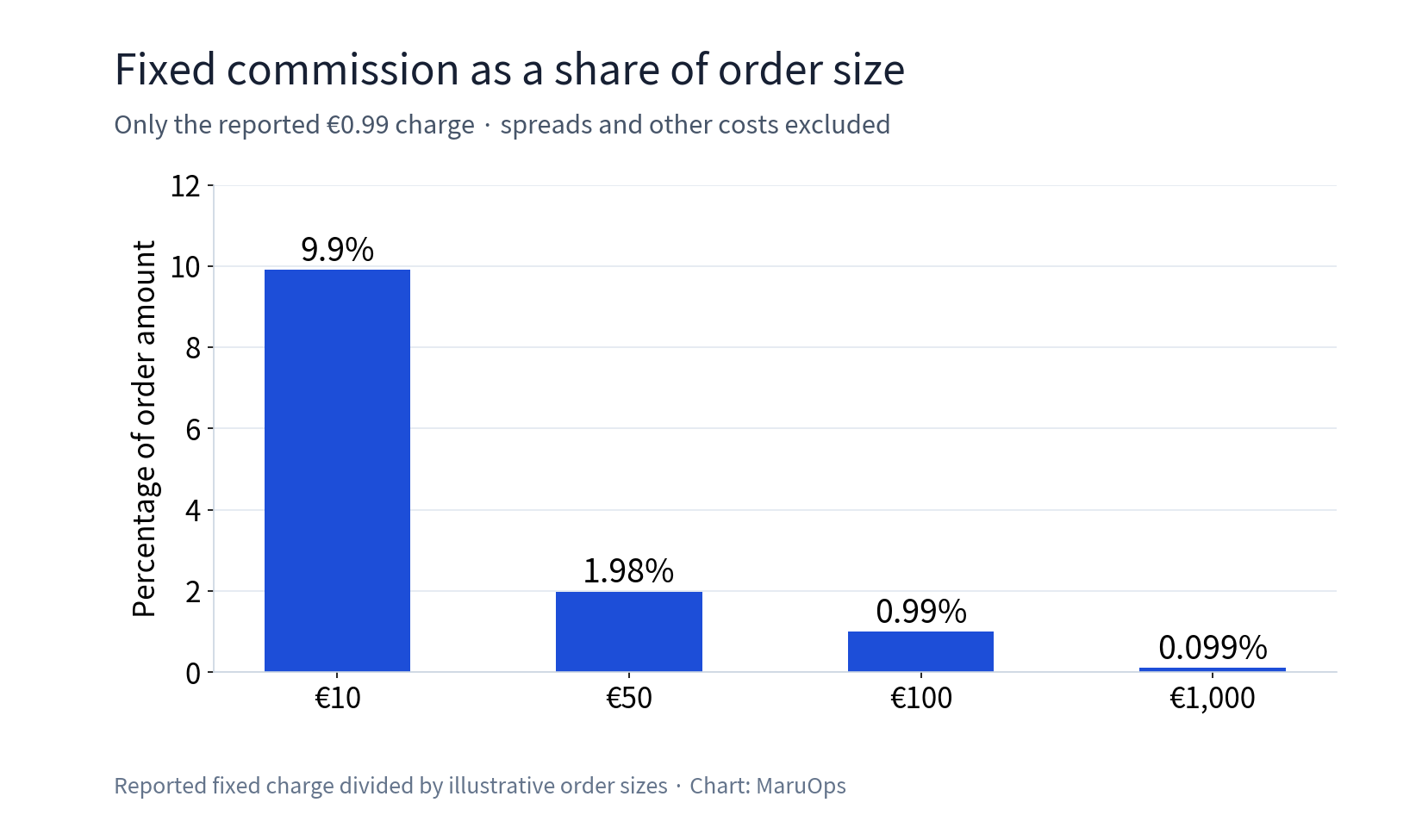
If buying and selling at an unchanged price each incurred the same fixed charge, the two fees would total €1.98. That is 1.98% of a €100 amount. This illustrates cost sensitivity rather than an observed round-trip result. Compare final executable purchase and sale prices as well as the explicitly displayed commission.
Look beyond the fixed order fee
The reported charge is €0.99 per order plus a spread. A spread is the difference between buying and selling prices or an adjustment relative to a reference price. Fixed charges can be proportionally larger on small orders.
Compare the final execution price, fees, custody and transfer conditions together. Easier access through banking is one development; the cost and limits of using that access are separate questions.
Order frequency matters for small recurring purchases. Ten hypothetical €10 orders incur €9.90 of fixed fees; one €100 order incurs €0.99. This isolates commissions on the same planned amount and excludes differences in purchase prices over time.
The example does not establish that combining orders is always preferable, because timing and cash availability also change. It does show why describing the charge as less than one euro is less informative than relating it to order size and frequency.
A spread is separate from a fixed commission. Waiving one component would not make total execution cost zero. Final prices and invoices are necessary for a meaningful comparison, regardless of the familiar banking interface.
Before turning a rollout into instructions
The shared Sparkasse name does not establish availability at every local bank. A launch date is not proof that the feature was activated in every customer account. The bank’s own rollout scope and app notices determine actual access.
Follow-up material should identify participating banks, contractual counterparties, charges and transfer restrictions. Adding another supported asset would not automatically change BTC custody or withdrawal rules. This is an example of crypto trading entering an established banking channel. Evaluate the convenience alongside costs and control to determine which use cases it serves.
Sources and further material
Deka official product information
Related reading
Standard Chartered launches direct Bitcoin trading for eligible UAE clients
Standard Chartered signs definitive agreements to acquire Zodia Custody



