
Report date: 2026-10-20 · Sources checked: October 24, 2026 (Korea time). Prices, balances and product terms refer to the cited reporting cutoff.
JPMorgan Asset Management modeled a 10% annualized base-case return for Bitcoin over the next decade. CoinDesk’s October 20 coverage also reported a -9.7% bear case and a 17% bull case.
Annualized expresses a long-period return in yearly terms. It is not a forecast of a 10% gain in every calendar year or an interest rate paid to customers.
On this page
What a long-term capital-market assumption is for
A decade-long assumption is an input for comparing long-horizon portfolios. It operates on a different timescale from predicting tomorrow’s close or selecting an entry price. Treating the base case as a target the market must reach changes the purpose of the model.
The distinction between adding returns and compounding them also matters. Compounding multiplies the result from one period by the return factor for the next. The Investor.gov calculator accordingly separates the assumed rate from the length of the investment period.
The spread between base, bear and bull cases is particularly relevant. A positive central assumption should be read alongside the loss scenario reported in the same analysis. The institution’s name does not remove uncertainty from those assumptions.
Why the other scenarios matter
Long-term models depend on assumptions about adoption, liquidity, regulation and other factors. Reading only the base case can make the possibility of losses in the same analysis disappear from view.
The coverage also described continuing concerns about volatility and unstable correlations. Publishing return assumptions should not automatically be interpreted as recommending that portfolios buy Bitcoin.
What the assumptions mean for a starting value of 100
For scale, apply each reported annualized rate as if it were earned at a constant compound rate for ten years. The formula is 100 × (1 + annual return) to the tenth power. Contributions, withdrawals, taxes and fees are excluded. These are explanatory calculations, not the model’s actual year-by-year path.
| Annual return assumption used | Calculated value after ten years, starting at 100 |
|---|---|
| Bear: −9.7% | About 36.05 |
| Base: +10% | About 259.37 |
| Bull: +17% | About 480.68 |
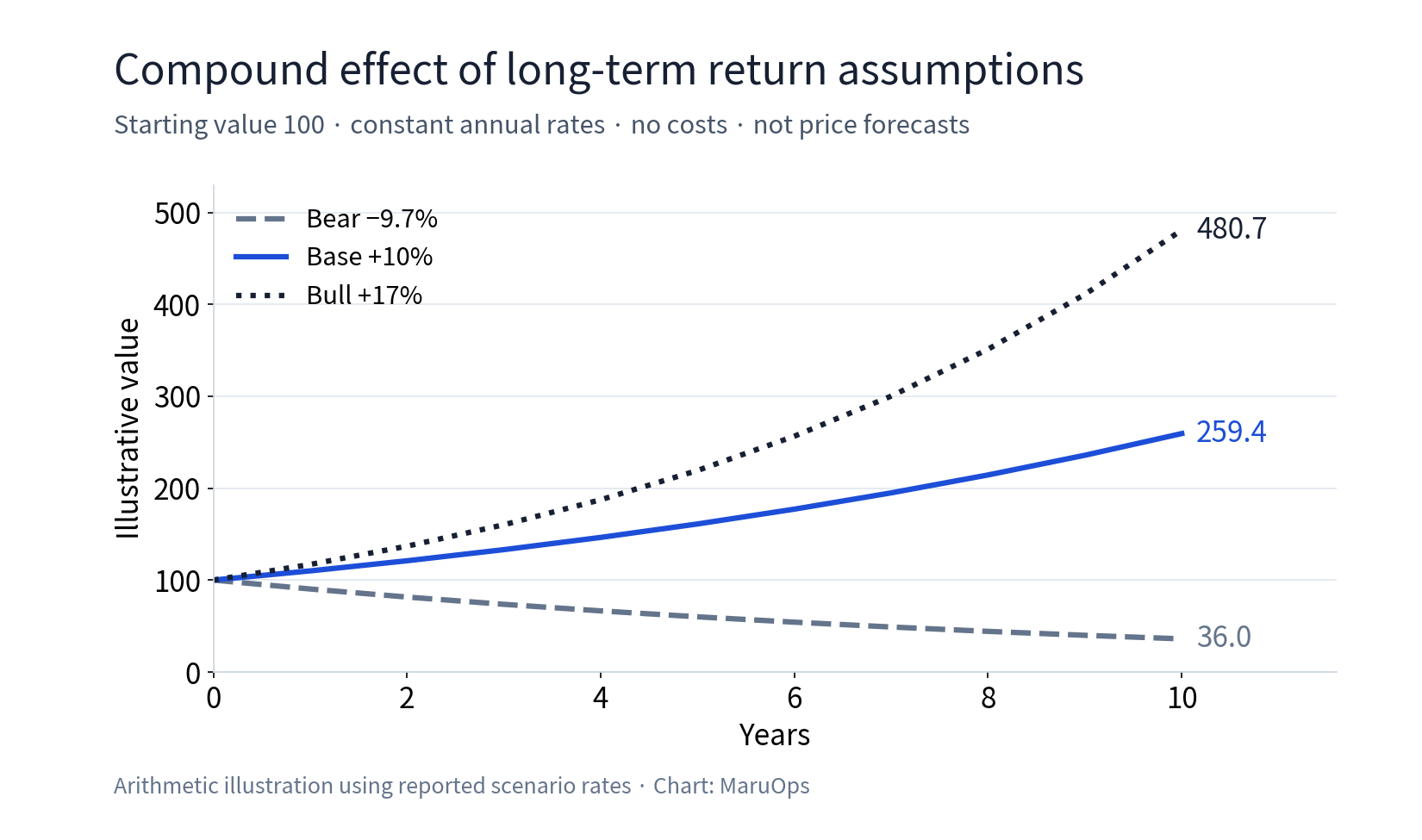
The wide separation does not reveal the probability of any scenario. Nor does the table provide the frequency of outcomes between them. A return assumption, a probability distribution and an investor’s actual cash flows are different objects.
Keep the forecasting basis attached
When citing a number, retain the institution, horizon, scenario and annualization basis. Arithmetic averages and compound returns also need to be distinguished when comparing figures from different tables.
The development is meaningful as Bitcoin’s inclusion in a traditional manager’s long-term analytical framework. Actual outcomes will depend on the subsequent price path and whether the model’s underlying assumptions hold.
Arithmetic averages can mislead. Returns of +50% and then −50% average to zero arithmetically, but turn 100 into 75. The two-year compound annual return is approximately −13.40%. This is a teaching example, not the report’s actual path.
Costs also compound. If a hypothetical asset gains 10% before an annual 1% asset charge, its growth factor is 1.10 × 0.99 = 1.089. That is not exactly the same as mechanically subtracting one percentage point. Actual charging arrangements matter.
These examples do not establish which costs JPMorgan included. The model’s return definition and the expenses of an actual investment vehicle need separate confirmation. Identical headline percentages can describe different quantities.
The path matters even when the endpoint matches
Two paths ending at the same price can involve very different interim losses. Someone needing liquidity or selling partway through cannot describe their experience with the final annualized number alone. Even the simple sequence of +50% followed by −50% turns 100 into 75, illustrating why fluctuating returns do not merely cancel out.
When comparing assets, read the volatility and correlation assumptions alongside expected returns. Diversification benefits cannot be assumed constant if BTC sometimes falls with equities. This story concerns an input to long-term analysis, rather than a fixed payment rate or a confirmed return for the coming year.
Sources and further material
JPMorgan long-term capital market assumptions
Investor.gov compound interest calculator
Related reading
Bitcoin volatility approaches Nvidia’s: comparing 90-day realized swings
Do Bitcoin ETF flows lead prices? DWF Labs studies 694 sessions



