Report date: 2026-10-22 · Sources checked: October 24, 2026 (Korea time). Prices, balances and product terms refer to the cited reporting cutoff.
Recovering Bitcoin hashrate has prompted an interpretation of indirect institutional confidence. October 22 reporting described CryptoQuant CEO Ki Young Ju’s focus on public miners backed by traditional financial investors.
The reported estimate recovered from a summer low near 726 EH/s to about 1,050 EH/s. Hashrate measures hash calculations per unit of time; one EH/s represents one quintillion calculations per second.
On this page
What the number measures
Mining machines repeatedly search for a block hash satisfying the required condition. Hashrate measures the speed of those attempts. It does not directly count users or transaction throughput. A 40% hashrate increase should not be described as a 40% improvement in payment speed.
The Bitcoin developer guide explains proof of work and difficulty adjustment. Because the system adjusts to changes in mining effort, a percentage increase in computing power does not translate directly into the same percentage increase in coin issuance.
Network hashrate is also different from an audited inventory of every machine. Estimates derived from observed blocks need consistent averaging windows. A short-lived jump is not sufficient evidence that a specific number of machines switched on that day.
Network capacity and miner profit differ
More computing power does not mean each machine becomes more profitable. A larger competing fleet can reduce an individual machine’s share of production. Electricity costs, hardware efficiency and mining difficulty also matter.
Daily estimates reflect randomness in block discovery. Comparing consistent averages from the same provider is more informative than treating a single day’s reading as a precise measure of installed equipment.
A 45% recovery can reduce one miner’s share
The increase from 726 to 1,050 EH/s is 324 EH/s. Dividing 324 by 726 gives approximately 44.63%, consistent with the reported recovery of about 45%. This is a change in estimated computing power, not Bitcoin’s price return.
Now assume an illustrative operator maintains exactly 1 EH/s throughout. Its simple share falls from 1/726 to 1/1,050. Holding other conditions constant, that relative share declines approximately 30.86%. This is not a measurement of any company’s actual production.
| Assumed network total | Simple share for a 1 EH/s operator |
|---|---|
| 726 EH/s | About 0.1377% |
| 1,050 EH/s | About 0.0952% |
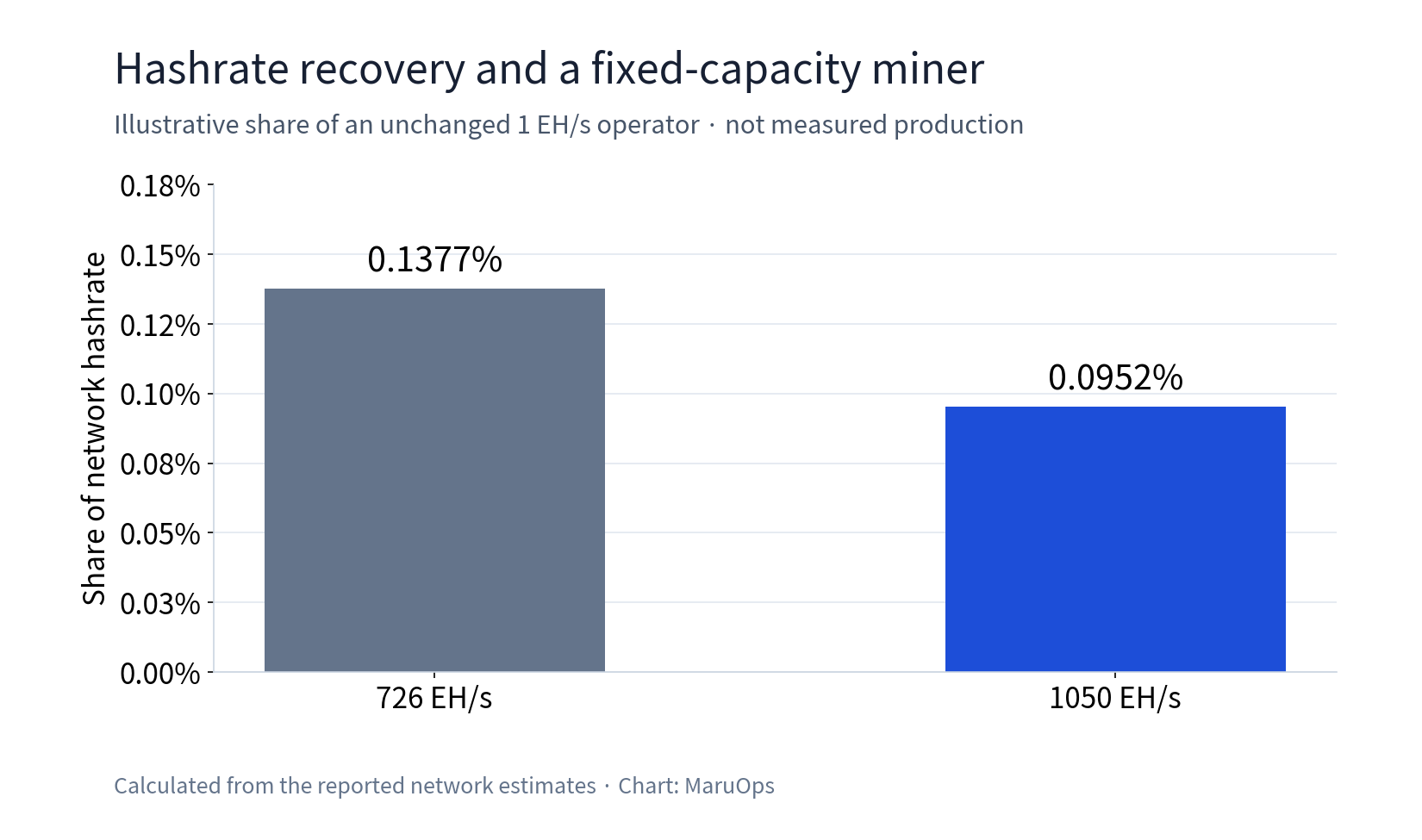
Stronger network competition and improving profits for an individual mining stock are therefore different developments. Equipment efficiency, electricity prices and uptime are needed to assess the business.
The limits of the institutional interpretation
Owning shares in a mining company is different from buying Bitcoin directly. An investor may also be interested in power assets, data centers or other parts of the business.
The statement is an analyst’s interpretation, not a verified price forecast. Keep the observation of changing network activity separate from the opinion that it signals future appreciation.
Equipment efficiency and total electricity use also differ. If hypothetical computing output doubles while power use rises 50%, energy per unit of work falls to 75% of its earlier level: 1.5 divided by 2. Total power use can rise while unit efficiency improves.
Efficient machines can still face unfavorable economics if electricity or hosting charges are high. Hashrate growth, improved efficiency and dollar profitability are separate steps requiring consistent prices and uptime data.
One network estimate also cannot identify every cause of recovery. New equipment, restarted capacity and the measurement window can play different roles. The analyst’s institutional interpretation requires evidence about investment and actual operations beyond the aggregate figure.
Infrastructure decisions can lag market prices
Equipment purchases and power arrangements cannot necessarily be expanded or reversed immediately after a price move. Capacity coming online now may reflect an earlier investment decision. Assuming the current hashrate directly reveals today’s price expectations can overlook that lag.
Compare consistently averaged network data with company-level operating capacity and production. Claims about financial institutions increasing their equity stakes require separate ownership disclosures. The news combines an observation about computing power with an interpretation about confidence. Keeping those distinct prevents a network statistic from becoming an unsupported stock or Bitcoin signal.
Sources and further material
Bitcoin developer guide: proof of work and difficulty
Related reading
NIP Group agrees to acquire another 4.47 EH/s of Bitcoin mining assets
Sazmining offers Proto hashboards: separating hardware and operating costs